Binomial (Terran): Ferrovespa socialis
Common (Terran): Iron Bugs/"The Bugs"
Self-Designation: [pheromone-complex; no auditory equivalent; see Designation section]
Biochemical Basis: Carbon-water, chitin-analogue exoskeleton with obligate metallic mineral integration
Body Plan: Bilateral hexapod arthropoid; progressive mineral-biological composite construction
Cognitive Architecture: Centralized neural ganglion chain with pheromone-mediated social processing
Homeworld: Crucible (high-gravity ferrous super-Earth, G-type star system)
Federation Status: Full member, ~8,200 years; self-achieved spacefaring
Uplift Status: Self-achieved; independent spacefaring prior to federation contact
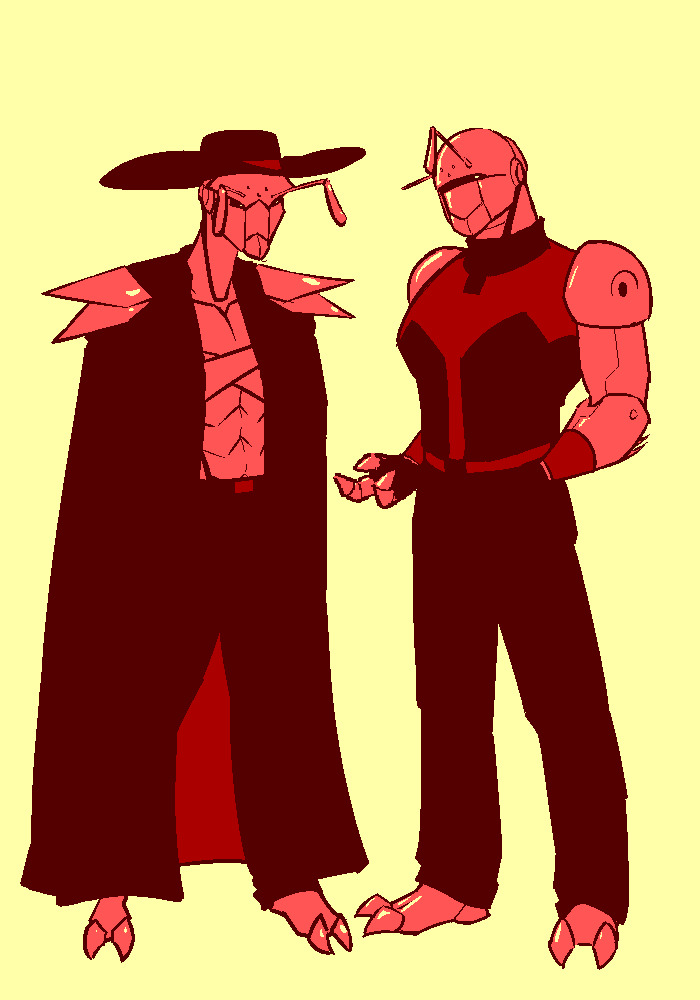
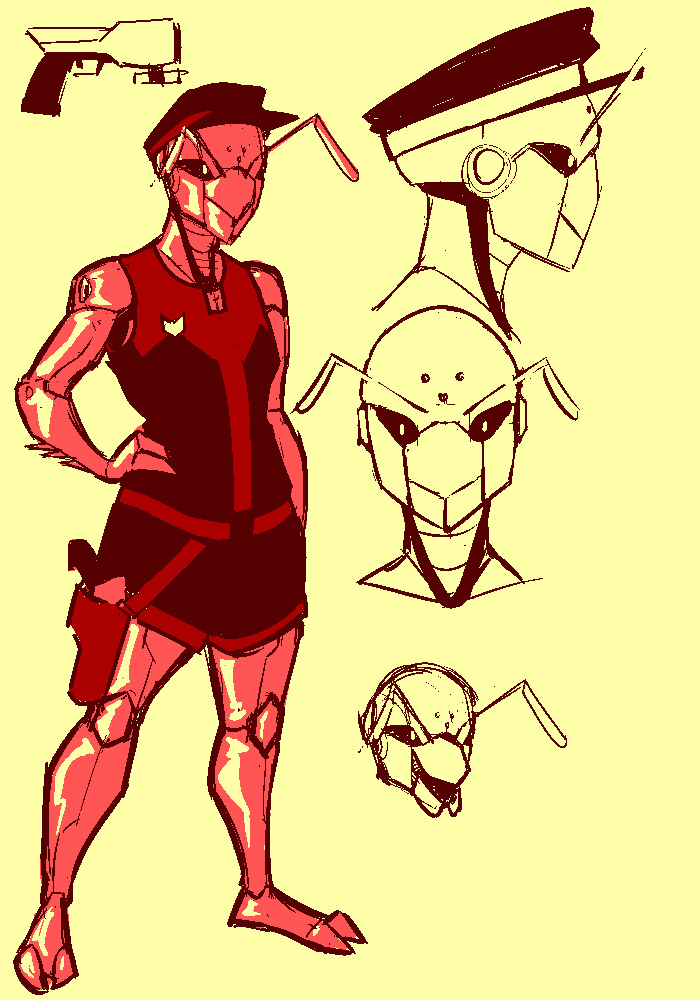
If you are about to meet an Apocritan and have thirty seconds: The organism in front of you is bilaterally symmetrical, roughly human-sized, with a segmented body, six limbs (four of which are typically configured as arms and two as legs, though this varies by phenotype), compound eyes, three infrared-sensing ocelli on the forehead, and a pair of antennae. Its body is a composite of organic chitin and integrated metal plating, and the ratio of organic to metallic material varies by age, caste, and individual circumstance. Some individuals are mostly biological with reinforcing plates at the joints. Others are almost entirely metallic, with organic tissue visible only at the seams. The plating is not armor worn over a body. It is part of the body. Do not ask them to remove it. Do not comment on its extent or quality unless you know them well enough to know their feelings about it.
Their primary communication is chemical (pheromone-based) and their spoken and written languages exist primarily for interspecies use. Your translator will handle their speech adequately. Level 2p-beta adjuncts to a translator collar can be utilized for translating pheromone communication.
Their society is organized by a caste system determined by chemical environment during larval development and maintained through pheromone-mediated food supply. This document describes that system as it currently operates. The editorial board is aware that the description will produce strong reactions in many human readers and has attempted to maintain descriptive accuracy throughout.
¶ COMMON DESIGNATION AND PRONUNCIATION GUIDE
Apocritans (ah-POCK-rih-tans): the human common name, derived from the Terran taxonomic suborder Apocrita, which contains all wasps, ants, and bees. The name was proposed informally during early contact by a xenobiologist who noted the morphological parallels to Terran hymenopterans and was adopted into general use before the nomenclature committee could convene. The committee subsequently ratified it on the grounds that attempting to replace an already-circulating informal name would be futile. Committee minutes note that the alternative proposal Ferrovespa socialis ("the social iron wasp") was adopted as the formal binomial without significant debate.
The common shorthand "Bugs" is in widespread informal human use. Apocritan diplomatic representatives have not objected to it. Whether this reflects genuine indifference, unfamiliarity with the mildly pejorative connotations of the English word, or a strategic decision not to expend political capital on naming conventions, is unclear.
The Apocritans' self-designation is a pheromone complex that has no auditory component and cannot be rendered in any human writing system. When asked to provide a spoken approximation for interspecies use, Apocritan representatives have given varying responses depending on caste, hive affiliation, and context. The most common spoken approximation translates roughly as "the built people" or "those who are made." The designation encodes caste, hive affiliation, and current queen lineage simultaneously; asking an Apocritan "what do you call yourselves" will produce a different answer depending on who is asking, who is answering, and what queen's pheromone environment the answering individual was raised in.
¶ BIOLOGY
¶ Overview
The Apocritan body plan is arthropoid: segmented, bilaterally symmetrical, with a chitinous exoskeleton, compound eyes, and jointed limbs. Adults are typically 1.4 to 2.1 meters tall in their standard bipedal configuration, with mass varying significantly depending on the extent of metallic integration (60-250 kg). The body is divided into three major segments: head, thorax, and abdomen, with six limbs originating from the thorax.
The most immediately visible feature is the metallic plating. Apocritan exoskeletons are composed of a chitin-analogue biopolymer that is structurally inadequate to support adult body mass at the homeworld's surface gravity (1.8g) without supplementation. Beginning in adolescence, the organism's biology drives the incorporation of environmental metals - primarily iron, but also copper, zinc, titanium, and various alloys depending on availability - into the exoskeletal structure. This is not a technological process in origin. It is a biological one: the organism deposits metallic minerals into the chitin matrix through biomineralization pathways analogous to calcium deposition in vertebrate bone, using specialized cells in the exoskeletal lining that extract dissolved metals from ingested material and deposit them in structured layers at load-bearing sites.
Technology has refined and extended this process substantially. Modern Apocritans supplement the biological mineralization with engineered plating, synthetic joint assemblies, and manufactured replacement components for both structural and organ systems. The boundary between "biological body" and "technological augmentation" is not clearly delineable in most adult Apocritans, nor do Apocritans consider this boundary meaningful. The integrated metal is not prosthetic in their understanding.
¶ Sensory Architecture
Vision is provided by two large compound eyes and three smaller ocelli. The compound eyes provide high-resolution vision across a wide field, with particular sensitivity in the yellow-green-red spectrum. The three ocelli, arranged in a triangle on the forehead, are sensitive to infrared wavelengths and provide thermal imaging capability. The combination allows Apocritans to assess the structural and thermal properties of materials by sight - a useful capacity for a species whose survival depends on identifying and evaluating metal-bearing substrates.
Chemoreception is the dominant social sense. The antennae are dense chemoreceptor arrays that detect airborne pheromones with high sensitivity and specificity. Apocritans can distinguish hundreds of distinct pheromone compounds at concentrations several orders of magnitude below what human instrumentation can reliably measure. Antennal contact - touching antennae to surfaces, objects, or other individuals - provides close-range chemical analysis comparable in informational density to a combination of human taste and smell but substantially more specific. Apocritans routinely touch objects and people with their antennae when investigating their environment. This is a sensory behavior, not a social gesture, though the distinction is not always clear to the individual doing it.
Mechanoreception is distributed across the exoskeleton and is particularly sensitive at the joints and at the interface between organic and metallic tissue. Apocritans are highly sensitive to vibration, impact, and pressure, which serves both environmental awareness and the ongoing monitoring of their own structural integrity. They are, at all times, proprioceptively aware of the load distribution across their skeleton in a way that humans, whose bones are internal and rarely at risk of structural failure, are not.
Audition is perceived through two ear-analogues located on the shoulder joints. Apocritans are specialized for low-frequency sounds, including infrasound, as well as high-frequency noises typically produced by scraping metal, but possess a notable auditory "blind spot" between 1000 and 2500 hz.
¶ Metabolism
Carbon-based, water-solvent, aerobic, with unusually high mineral throughput. The metabolic demands of maintaining both organic tissue and integrated metallic structures require continuous dietary input of both organic nutrients and bioavailable metals. Apocritan digestion includes specialized mineral-processing organs - a series of muscular chambers lined with acid-secreting tissue, functionally analogous to a bird's gizzard - that extract metal ions from ingested material and route them to the biomineralization pathways.
Adults cannot process solid food. The adult digestive tract is narrowed and simplified relative to the larval form, optimized for processing a liquid nutrient medium produced by larvae (see Lifecycle and Food Chain). This dependency is the foundation of Apocritan social structure and is discussed at length in the relevant sections.
¶ Lifecycle
The Apocritan lifecycle involves four stages, with approximate durations given for the worker caste. Queen and drone lifespans differ substantially (see Caste System).
Egg (~1 standard year). Eggs are laid by queens and require warm, stable incubation conditions. Hive nurseries maintain temperature and humidity within narrow tolerances. Eggs are tended by designated worker cohorts throughout the incubation period.
Larva (~15 standard years). Larvae are soft-bodied, limbless, and voracious. They are omnivorous, consuming large quantities of organic material - primarily cultivated protein stocks and fruit-analogue crops - and grow to roughly the mass of a large dog before pupation. Larvae excrete a processed nutrient medium (see Food Chain) that constitutes the sole food source for adult Apocritans.
Pupa (~1 standard year). The larva spins a cocoon of silk-analogue and mineral-impregnated fiber and undergoes metamorphosis. The adult body plan assembles within the cocoon. The individual emerges as a soft-bodied, pale adolescent whose exoskeleton has not yet hardened or mineralized. This is the most physically vulnerable stage of the adult lifespan.
Adult (variable; see Caste System). Post-emergence, the exoskeleton hardens and the biological mineralization process begins. The adolescent individual receives their first fitted plating to supplement the incomplete exoskeleton. From this point, the process of progressive construction - biological mineralization supplemented by technological augmentation - continues throughout the individual's life. There is no stage at which the body is "finished."
¶ The Food Chain
The adult dependency on larval excretion is the single most consequential biological fact about Apocritan civilization.
Adult Apocritan digestive systems cannot process solid food. The esophageal and intestinal passages are narrowed during metamorphosis, optimized for liquid nutrient absorption. The nutrient medium they require is produced exclusively by larvae, who consume solid organic material, metabolize it, and excrete a processed liquid (colloquially "honey," though it bears little resemblance to the Terran substance beyond being a viscous, nutritious secretion produced by a social organism).
The honey is not merely food. The queen's pheromone signature is present in the chemical environment of the nursery. Larvae raised in a queen's nursery intake her pheromone output as part of their ambient chemical environment. These pheromones are not fully metabolized by the larvae - they are present in the excreted honey at detectable concentrations. Adults consuming honey from a given queen's nursery are therefore ingesting that queen's pheromone signature with every meal.
The neurochemical effects of chronic queen-pheromone ingestion are well-documented by federation xenobiologists and are significant. The pheromones modulate baseline neurological activity in the adult brain, influencing mood regulation, hierarchical perception, caste-identity reinforcement, and social bonding with hive members. The effects are not coercive in the sense of overriding individual decision-making. They are environmental in the sense of shaping the neurochemical baseline from which decisions are made. A worker raised on a specific queen's honey does not obey that queen because the pheromones compel obedience. The worker perceives that queen's authority as natural, her directives as reasonable, and her hive as home, because the worker's neurochemistry has been continuously calibrated to that queen's chemical signature since the worker's first meal as an adult. The distinction between "compelled" and "shaped" is meaningful but, the editorial board notes, less comforting than it might initially appear.
Synthetic production of nutritionally adequate adult food - chemically complete but free of queen pheromones - is technologically feasible and has been demonstrated by federation xenobiologists as well as by Apocritan researchers working outside queen-controlled institutions. The social, political, and legal status of synthetic food varies by hive and queen. In most major hive-ships, synthetic food production is restricted or prohibited.
¶ CASTE SYSTEM
¶ Determination
All three Apocritan castes - queen, drone, and worker - are genetically possible outcomes from any fertilized egg. Caste is determined epigenetically by the chemical environment during larval development, primarily through pheromone concentrations in the nursery atmosphere and in the food provided to the larva. A queen controls caste ratios in her hive by controlling the chemical environment in which her larvae develop.
Workers constitute approximately 90% of the population. They are technically female, with functional but underdeveloped reproductive systems. A worker who mated with a drone could produce viable offspring, though in smaller clutches than a queen. This biological capability is socially suppressed.
Queens constitute approximately 5% of the population. They are the only individuals authorized to reproduce within the standard social framework. Queen-determination requires specific pheromone conditions during larval development that queens carefully control. The distinction between a queen and a worker is not genetic but developmental: a worker-destined larva redirected into a queen-development pheromone environment would develop into a queen.
Drones constitute approximately 5% of the population. They are male, smaller-framed than workers, and not subject to the same mineral-integration demands, as their social role does not include physical labor. Drone lifespans are shorter than worker lifespans (approximately 30-40 standard years, compared to 60-70 for workers and several hundred for queens), a differential that federation xenobiologists attribute primarily to the metabolic demands of continuous reproductive activity rather than to inherent biological limits.
¶ Social Roles
Workers perform all labor - construction, resource extraction, agriculture, manufacturing, military service, and hive maintenance. Worker phenotypes are differentiated by pheromone-mediated developmental conditions, producing individuals with specialized body plans suited to specific roles. The degree of specialization varies. Some workers are broadly capable generalists. Others are highly specialized, with body plans and integrated augmentations optimized for a single function, making career changes physically difficult or impossible.
Workers are further subdivided along morphological lines that the Apocritans categorize into three broad groups, here rendered with their Terran-analogue common names:
Wasps are the generalist morphotype and the most socially mobile caste-subdivision. They occupy military, governmental, and administrative roles preferentially. Soldier is the prestige career for wasps, and the military represents the primary pathway to social advancement. Wasps make up the bulk of Apocritan governmental structures and foreign-contact personnel. Most Apocritans that humans will encounter in federation contexts are wasps.
Ants are the heavy-labor morphotype, characterized by larger mandibles, greater morphological variation between individuals, and a higher degree of phenotypic specialization. Ant workers include the most extremely specialized body plans in the species - individuals engineered from adolescence for a single function, with integrated augmentations that make them exceptionally capable at their designated task and poorly suited for anything else. Ants are socially confined to industrial and construction work.
Bees are the care-and-maintenance morphotype, characterized by a finer exoskeleton texture (described by human observers as "fuzzy" or "furred") and typically a less heavily augmented body plan. Bees occupy roles in food production, larval care, hive maintenance, hospitality, and service work. The closest human analogue to the social position of bees is the historical category of "pink-collar" labor: essential, undervalued, and gendered.
Drones occupy no labor role. They are housed in queen-maintained quarters, provided with preferential nutrition, and expected to be available for reproductive service. Social movement outside the queen's quarters is permitted but not encouraged. Drone culture, to the extent that it is visible to outside observers, centers on the domestic sphere. Drones who are not faithful to their assigned queen are subject to execution, and any eggs sired outside the queen's authorization are destroyed when discovered.
Queens manage the hive: controlling reproduction, overseeing nursery conditions (and therefore caste ratios), maintaining the pheromone environment that structures social cohesion, and directing resource allocation. A queen's power is not primarily political in the human sense, but is instead biological (See: Right of Death and Power over Life, Foucalt, PC. 1976). She controls the food supply by controlling reproduction, she controls caste determination by controlling nursery chemistry, and she controls social cohesion by controlling the pheromone environment in which all of her hive's adults were raised. Political authority follows from these biological controls rather than preceding them.
¶ Worker Culture
Workers constitute the vast majority of Apocritan society and have developed cultural forms that are substantially independent of queen-directed social structures, though they operate within the constraints those structures impose.
Sexual and romantic relationships among workers are common and are generally tolerated or actively encouraged by queens, as pair-bonded workers who are sexually satisfied within the worker population are less likely to seek out drones. Worker sexual culture has developed its own norms, aesthetics, and symbolic vocabulary. The ovipositor/stinger - the anatomical structure associated with the worker's suppressed reproductive capacity - occupies a psychosexual position in worker culture analogous to the phallus in many human cultures, functioning as a symbol of potency, aggression, and gendered identity. Weapons, particularly firearms and bladed weapons, are colloquially referred to as "stingers" in worker slang.
Worker culture includes a well-developed butch/femme dynamic that maps, in a limited and imperfect way, onto the queen/drone social roles. "Queen" and "drone" are used as slang terms within worker romantic and sexual culture, denoting dominant and submissive roles respectively. Workers who adopt "drone" presentation - softer mannerisms, domestic focus, deliberate downplaying of their stinger - do so as a cultural and erotic choice within a social context where actual drones are an inaccessible and strictly controlled class. The dynamic is imitative, subversive, and entirely internal to worker culture.
The body itself is a site of cultural expression. Because the Apocritan body is progressively constructed - plating chosen, augmentations selected, components replaced over time - the specific aesthetic choices made during this process function as simultaneous identity performance and genuine self-construction. Plating style, surface finish, component selection, and the balance between organic and metallic coverage are legible social signals within Apocritan culture. Clutchmates - individuals from the same egg cohort - are often visually recognizable because their initial plating was fabricated from the same material stock, producing shared surface coloration and metallurgical properties. This shared material signature functions as a kinship marker, though kinship in Apocritan society is primarily hive-based rather than clutch-based.
¶ REPRODUCTION AND SEXUALITY
¶ Standard Reproductive Cycle
Reproduction in Apocritan society is queen-controlled. Queens mate with drones maintained in their household, lay eggs, and determine the developmental conditions - and therefore the caste outcomes - of the resulting larvae. Clutch sizes are large (50-200 eggs per laying cycle) and laying cycles are frequent relative to human reproductive rates. Queens are prolific by necessity: the hive requires continuous larval populations to maintain the adult food supply.
Worker reproduction is biologically possible but socially prohibited in most hive contexts. A worker who mates with a drone and produces offspring does so in violation of the queen's reproductive monopoly, which is both a social transgression and, in many hives, a capital offense - for the drone. Unauthorized eggs, when discovered, are destroyed. The enforcement is asymmetric: the drone is executed, the worker is typically punished but not killed (workers are labor assets; their loss has economic cost), and the eggs are eliminated as a threat to the queen's control over caste ratios and hive composition.
¶ Interspecies Reproductive Mutualism
Apocritan eggs benefit from incubation in warm-blooded hosts. The biological basis for this is thermoregulatory: eggs incubated in a living host with dynamic temperature regulation, immune-system-mediated pathogen suppression, and biochemical signaling between host tissue and egg membrane show improved developmental outcomes compared to eggs incubated in static hive nursery conditions. The mechanism is not parasitic - the eggs do not feed on the host, and the host does not suffer tissue damage from the process - but it is intimate, involving implantation of eggs in the host's reproductive tract and a gestation period during which host and eggs exchange hormonal signals.
On the homeworld and in hive-ship contexts, environmental incubation (heated mineral baths, temperature-controlled nursery chambers) is standard. Living-host incubation is a luxury practice: metabolically unnecessary, developmentally advantageous, and socially prestigious. The use of living incubators from other species - in federation contexts, through compensated surrogacy arrangements - is legal and regulated under federation interspecies reproductive protocols.
The experience of serving as an incubator is, by consistent report from human surrogates, physically intense and hormonally significant. The biochemical crosstalk between host and eggs produces documented effects including elevated oxytocin analogues, altered sleep patterns, and a bonding response that surrogates describe in terms ranging from "maternal" to "profoundly weird." A subculture of human surrogates exists within federation space.
¶ HOW THEY THINK
¶ The Self as Project
The central fact of Apocritan psychology is that the self is understood as an ongoing construction process rather than a stable entity.
An Apocritan begins life as a soft-bodied organism with an inadequate skeleton. Over the course of adolescence and adulthood, they are progressively built - by biological processes, by technological augmentation, and by the social and economic systems that determine what materials and modifications are available to them. The body they inhabit at any given moment is a snapshot of a process that began at emergence and does not end until death. Components are replaced, systems are upgraded, damage is repaired with materials that may differ from the originals. The question "is this the same body I started with?" has no meaningful answer, and Apocritans generally do not ask it.
This produces an identity framework that differs from those of other major federation species. The Weavers locate identity in the cognitive pattern, which can be compressed, stored, and reconstituted independent of substrate. The Ansale'wit locate identity in the relational expression - the signal as shaped by the network it inhabits. Humans locate identity in the continuity of subjective experience. Apocritans locate identity in the process itself: the ongoing act of building, modifying, and maintaining the self.
The philosophical implications are significant and are discussed in federation comparative-identity literature at length. One consequence worth noting here: Apocritans have a relationship to material provenance that other species find difficult to understand. The specific metal in an Apocritan's plating matters to them - not because the metal is "them" in the way that a Weaver's pattern is "them," but because the metal's origin, quality, and history are part of the story of their construction. Clutchmates share material signatures. A worker who upgrades their plating with salvage from a decommissioned ship carries that ship's history in their body. The materials are not the self, but they are the medium of the self's ongoing project, and they are not interchangeable.
¶ Pheromone Processing
Apocritan cognition is individual in architecture - there is no distributed processing, no network effect, nor a hive mind in any technical sense. Each individual possesses a centralized neural system that processes information independently.
However, the pheromone environment constitutes a continuous chemical information layer that shapes cognitive processing in ways that are not fully separable from "individual thought." An Apocritan in a hive environment is receiving constant pheromone input from the queen (via food), from nearby workers (via ambient chemical signaling), and from the environment itself (which retains pheromone residues). This input influences mood, attention, social perception, and motivation at a level below conscious deliberation. Apocritans do not experience this as external influence. They experience it as how they feel. The distinction between "what I think" and "what the pheromone environment is making me think" is not perceptible from inside.
Apocritans who have spent extended time outside queen-pheromone environments - on federation stations, in independent settlements, or in rebel-held territories where synthetic food is available - consistently report a period of cognitive adjustment that is described in terms translatable as "clearing," "waking up," or "becoming loud." The experience is not uniformly positive. Some describe it as liberation. Others describe it as disorientation, loss of social grounding, or an anxiety comparable to the Ansale'wit experience of signal starvation. The pheromone environment is a constraint. It is also a structure. Not everyone who is freed from a structure experiences the freedom as improvement.
¶ The Husk Problem
When an Apocritan's organic nervous system degrades beyond function - through age, injury, or disease - the integrated mechanical and structural systems may continue to operate. The resulting object is termed a "husk": a body that is structurally intact, mechanically functional, and neurologically dead.
Husk reclamation - the recovery and reuse of a deceased individual's integrated components - is standard practice and is not culturally sensitive. Components are components; their reuse is economical and is broadly analogous to human organ donation.
The culturally sensitive practice is husk operation: the remote control of a neurologically dead body via external signal input to its mechanical systems. This practice has historical precedent in several Apocritan cultures and has been employed for both labor and military purposes. It is currently uncommon and is regarded with varying degrees of discomfort across different hive cultures.
The discomfort is philosophical rather than practical. In a species whose identity is constituted by the ongoing process of self-construction, the husk represents a specific horror: a completed project with no builder. The implications for a species that locates selfhood in the act of construction are considerable, and the editorial board notes that Apocritan philosophical and religious traditions contain extensive writing on the subject, very little of which has been translated into human languages.
¶ HOW THEY BUILD
¶ Material Integration Engineering
Apocritan technology is built on the same principle as Apocritan biology: the progressive integration of metallic and organic materials into composite structures where the boundary between the two is not meaningful.
Their engineering tradition began with the refinement of the biological mineralization process - better metals, more precise deposition, stronger alloys - and extended outward from the body to the environment. Apocritan construction is fundamentally metallurgical. Where Weavers grow circuit-sponges and Ansale'wit grow fungal architecture, Apocritans smelt, alloy, cast, forge, and fabricate. Their manufacturing base is extractive and industrial: mining, refining, and metalworking at scales that federation observers have described as "voracious."
The hive-ship is the characteristic large-scale Apocritan structure. Hive-ships are mobile manufacturing platforms, typically kilometers in scale, that travel between resource-rich systems consuming asteroids, comets, and in some cases planetary surface material to feed the hive's material needs. The ship is not a vehicle in the human sense. It is a self-sustaining industrial ecology: mines, refineries, forges, nurseries, agricultural bays, and living quarters integrated into a single structure that grows and modifies itself continuously as resources allow.
Apocritan engineering is strong in materials science, metallurgy, mechanical systems, and industrial-scale manufacturing. It is comparatively weak in biology, chemistry (outside of metallurgical chemistry), and information technology. Their computing systems are functional but unsophisticated by federation standards - adequate for navigation, manufacturing control, and communication, but not competitive with more sophisticated systems, including Human computing. Apocritans compensate for computational limitations with mechanical solutions: where another species might simulate a structural problem, an Apocritan engineer will build a physical model and test it to destruction.
The engineering culture is practical, empirical, and deeply uninterested in elegance for its own sake. A thing works or it does not. If it does not, you rebuild it with better material or better engineering. If it does, you move on. The aesthetic dimension of Apocritan engineering exists - the plating styles, the hive-ship ornamentation, the visual vocabulary of caste and status expressed through material choice - but it is secondary to function in a way that Weaver engineers (for whom integration is the aesthetic) and human engineers (for whom elegance is a professional value) find somewhat bleak.
¶ HOW THEY RELATE
¶ Hive Structure
The fundamental social unit is the hive, organized around a queen and her reproductive monopoly. A hive is simultaneously a family, a polity, and an economy. The queen's biological controls - over reproduction, food chemistry, and caste determination - make the hive a more tightly integrated social unit than any human institution. Members of a hive are chemically bonded to it through the food supply in a way that makes "loyalty" a misleading term. It is not that hive members choose loyalty. It is that their neurochemistry has been shaped, from their first adult meal, to experience the hive as the natural context of their existence.
Inter-hive relations are competitive and frequently hostile. Queens compete for resources, territory, and access to high-quality materials. Hive wars - military conflicts between hive-ships - are a persistent feature of Apocritan civilization and are the primary context in which the wasp military caste operates. The federation's cooperative framework constrains inter-hive conflict to the extent that it prohibits the use of certain categories of weapons and the targeting of non-Apocritan assets, but intra-species conflict is classified as an internal matter and is not subject to federation intervention in most circumstances.
¶ Interspecies Relations
Apocritan engagement with the federation is transactional. They participate in the cooperative framework because the framework provides access to resources, trade networks, and technological exchange that are materially beneficial. They comply with federation prohibitions on planet-cracking, system-scale and stellar-scale weapons, and the exploitation of pre-spacefaring sophonts because the costs of non-compliance (federation exclusion) exceed the benefits. Their compliance is a cooperative strategy adopted because it is the dominant strategy under the current payoff structure, not because cooperation is a terminal value.
This is not unusual in the federation. Many member species cooperate for instrumental rather than intrinsic reasons, and the federation's framework is explicitly designed to accommodate this. The Apocritans are notable primarily for the transparency with which they conduct their instrumental cooperation. They do not pretend to share the prosocial values that characterize many other species. They are in the federation because it is useful to be in the federation. This is, in the editorial board's assessment, a more honest posture than that adopted by some federation members who claim prosocial motivations while behaving instrumentally.
¶ HOMEWORLD
¶ Crucible
The Apocritan homeworld - designated Crucible by the Terran Astronomical Survey based on Apocritan terminology - is a super-Earth of approximately 4.2 Earth masses, orbiting a G-type main-sequence star at 1.1 AU. Surface gravity is approximately 1.8g. The planet is tectonically hyperactive, with extensive volcanism, a high mean surface temperature, and a dense, mineral-laden atmosphere.
The defining geological characteristic is the abundance of bioaccessible metals in the surface environment. Crucible's crust is iron-rich, with surface and near-surface deposits of ferrous and non-ferrous metals at concentrations far exceeding terrestrial norms. Hydrothermal systems cycle dissolved metals through the hydrological system continuously. Soil, water, and even the lower atmosphere contain metallic particulates at biologically significant concentrations. The entire biosphere is metal-integrated: Crucible organisms, from the simplest unicellular forms to the largest megafauna, incorporate environmental metals into their structures as a basic survival strategy in the high-gravity environment.
The landscape is, by human aesthetic standards, industrial before industrialization. Exposed metal-bearing rock formations. Rivers stained with dissolved iron compounds. Soil with a visible metallic sheen. Vegetation - or the Crucible equivalent, a radiation-resistant ground cover based on a chitin-analogue structural polymer rather than cellulose - that incorporates enough metal to be detectably magnetic. The biosphere smells, to human visitors, like a machine shop: iron, ozone, and hot metal.
Crucible's high gravity shaped the Apocritan body plan and through it the Apocritan mind. Everything on Crucible is heavy. Flight is metabolically prohibitive for large organisms. Structural failure is a constant selective pressure. The organisms that survived were the ones that found ways to make their bodies strong enough, and the available way - given the planet's geochemistry - was metal. The Apocritans are Crucible's answer to the question: what does intelligence look like when it evolves on a planet where standing up is an engineering problem?
¶ EVOLUTIONARY HISTORY
The ancestors of Ferrovespa socialis diverged approximately 180 million years ago in Crucible's equatorial volcanic zone as colonial burrowing organisms, building hive structures in thermally stable underground chambers near hydrothermal vents. The colonial social structure - reproductive specialization, caste differentiation, cooperative brood care - predates sapience by tens of millions of years.
Early ancestors incorporated environmental iron into their exoskeletons passively, through dietary intake and ambient mineral exposure. The selective pressure was structural: in 1.8g, an organism that could reinforce its exoskeleton with iron outcompeted one that could not. Over tens of millions of years, the passive process became active - specialized biomineralization cells, targeted mineral deposition, enzymatic pathways for extracting and processing specific metals. The organism's relationship to its environment shifted from "incidentally absorbing metals" to "actively mining its own food for structural material."
Tool use emerged approximately 6 million years ago - not as a cognitive breakthrough but as an extension of the biomineralization behavior. Early tool use consisted of shaping available metal-bearing rocks for use as structural supplements: external braces, load-bearing supports, impact-resistant covers. The transition from "finding useful rocks" to "making useful shapes from rocks" to "smelting ore" was, by the evolutionary record, continuous. There is no bright line between Apocritan biology and Apocritan technology. The technology is what the biology became when it exceeded what the body could do unaided.
Civilization appeared approximately 300,000 years ago. Industrialization approximately 14,000 years ago. Spacefaring approximately 9,000 years ago. Federation contact approximately 8,200 years ago. The transition from planetary to spacefaring was driven by resource pressure: Crucible's accessible metal deposits, while abundant by terrestrial standards, were being depleted by a growing industrial civilization with a biological need for metal.
¶ HISTORY WITH US
¶ Contact
Human-Apocritan contact occurred in Year 18 post-reconstitution, when an Apocritan hive-ship transiting the outer Sol system responded to human navigational broadcasts. The encounter was unplanned by both parties. The hive-ship was in transit between resource systems and had no prior awareness of Sol's post-reconstitution status. The human contact team had no prior experience with Apocritans specifically, though federation archives provided baseline information.
Initial contact was conducted through standard federation protocols and was described by the human contact team as "efficient." The Apocritan contact delegation - wasp-caste, military-adjacent, authorized to negotiate resource-access agreements - assessed the Sol system's available resources, determined that the system was claimed and populated, confirmed federation membership, and departed through cheat-space within three standard days. Trade negotiations began through federation channels within the year.
¶ Current Relations
Human-Apocritan relations are primarily economic and are conducted primarily at the working level. The species trade actively: human computational technology and cultural products in exchange for Apocritan metallurgical expertise and refined materials. Joint engineering projects - particularly in habitat construction and materials science - have produced practical results that both species value.
The political dimension is more constrained. Human institutional values and Apocritan social structure are in tension on fundamental points - individual rights, reproductive autonomy, caste-based labor allocation - that neither side expects to resolve through diplomatic engagement. The prosocial federation species' long-term strategy regarding Apocritan social reform is conducted through soft-power channels (trade dependency, cultural exposure, support for reform factions) and operates on civilizational timescales. Apocritans are, generally, aware of this aspect of their relationship to the federation.
The editorial board notes that the most significant developments in human-Apocritan relations have not occurred at the diplomatic level. They have occurred in the frontier zones where hive-ship workers and human settlers interact directly: trading, working, drinking, fighting, and occasionally forming relationships that neither species' institutional framework fully anticipated. The field guide cannot adequately represent these interactions because they are, by their nature, informal, undocumented, and conducted by people who are not writing reports about them.
¶ ON THE UPLIFT DEBATE
The Apocritan position on the Weaver uplift methodology is less frequently cited in federation ethical discourse than the Ansale'wit position, but it is distinctive and warrants documentation.
The Apocritans achieved spacefaring independently. They were not uplifted. Their civilization, with its social structure intact, survived the pre-spacefaring period through its own efforts and on its own terms. Their position on the uplift debate is informed by this fact.
Apocritan official (queen-authorized) commentary on the Atma program has been consistent: the Weavers' error was not the dissolution, the nonconsensual intervention, or the archival process. The error was the reconstitution of archived individuals into unaugmented biological bodies. In the Apocritan understanding of selfhood - where identity is constituted by the ongoing process of construction and modification - restoring an individual to a baseline biological state was a grotesque and insulting hamstringing, and that the Atma program should have provided fully-mechanical interfaces for the stored engrams.
Worker-class commentary, where it has been recorded, is more varied and more pointed. Some workers have expressed the view that the Atma program is simply the Weaver version of what queens do: dissolving individual autonomy in service of a system that claims to be acting in the interests of those it controls, maintaining the subjects in a state determined by the controller rather than the subject.
¶ CONTRIBUTOR NOTES
The word that kept coming to mind, and that I kept trying to replace with something more professional, was "familiar." I spent six weeks embedded with a mixed wasp-ant work crew on a resource extraction operation in the belt, and the social dynamics were familiar. The hierarchy was familiar. The way the senior workers hazed the juniors was familiar. The way everyone complained about the food was familiar. The way they personalized their equipment and plating - stickers, paint, etchings, little modifications that served no functional purpose but said this one is mine, I am the one who made this choice - was familiar. I have read Dr. Okonkwo's caution against projecting human social frameworks onto alien civilizations and I agree with it in principle. In practice, I stood in the crew mess of an Apocritan mining ship and watched two ant workers argue about whose turn it was to clean the slag trap and I thought: I have been in this room before. The room was a sheet metal shop in Guangzhou, and the workers were human, and the argument was about whose turn it was to sweep.
- Dr. R. Tseng, industrial sociology, University of Nanjing-Shanghai, Year 24 post-reconstitution
Their word for what they do to their bodies - the plating, the augmentation, the replacement of organic with engineered - translates into seventeen different human languages and lands differently in every one. In Mandarin it's closest to 修 (xiū), which means to repair, to cultivate, to practice. In English the best we've managed is "building" and it's not good enough. In the Apocritan pheromone-language the concept carries valences of growth, obligation, artistry, and identity simultaneously. You don't "get" plating the way you get a tattoo. You don't "install" it the way you install a prosthetic. You - there is no English verb for this. You become through it. They are a species for whom the process of embodiment is a lifelong craft project, and some of them are doing it with materials they didn't choose, in configurations they didn't select, in service of a queen they can't neurochemically disentangle from, and they still find ways to make it mean something personal. I find this admirable in a way that makes me uncomfortable, because admiring someone's ability to make meaning inside a system of coercion is dangerously close to admiring the system.
- Dr. A. Carver, xenopsychology, Philadelphia Institute of Xenopsychology, Year 29 post-reconstitution
I was offered a surrogacy contract by a queen through a diplomatic intermediary. Standard terms, generous compensation, full medical support. I declined. I am noting this here not because my personal medical decisions are relevant to a field guide, but because the offer itself is relevant: it was extended as a diplomatic courtesy, the way a human host might offer a guest room. She was being polite. The fact that what she was politely offering was the use of my reproductive tract as an incubator for her offspring is the kind of detail that you either find horrifying or unremarkable depending on how much time you've spent with Apocritans, and I have spent enough time with them to find it merely startling, which is a shift in my own reactions that I am still processing.
- J. Madaki, field xenology, University of New Lagos, Year 26 post-reconstitution
My counterpart on the joint hull-alloy project was an ant worker whose designation translated as something like "Furnace-Mouth." She had been doing metallurgical work since emergence - over forty years - and her body reflected it: heavy thoracic plating in a copper-iron alloy that she had, over decades, refined and replaced until it was a custom composition that she said no one else in her hive shared. It was her masterwork. Not a product she had made - herself, the thing she had made herself into. When I complimented it she touched my hand with her antenna and said something my translator rendered as "you are the first person from outside to notice that it is mine and not my queen's." I think about that sentence often. The plating was hers. The metal came from her queen's asteroid. The design was shaped by her queen's caste-assignment. The body it was integrated into was developed in her queen's nursery. And it was hers. I think humans have done this in every company town and every factory floor and every system that tried to make people into components.
- Dr. Y. Kobayashi, materials engineering, University of New Osaka, Year 31 post-reconstitution